158th Edition
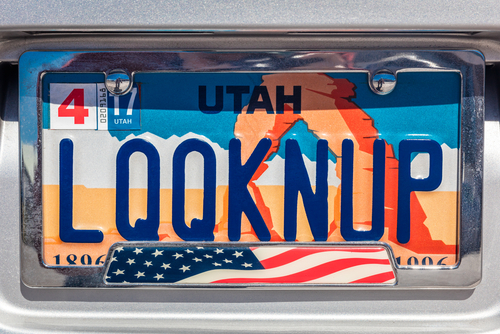
License plates
I’ve never ordered a vanity license plate, but I think some of them are really cool. My two favorites were both on red sports cars. One was a corvette and the tag said, “Was His.” Clever. The second was on a Ferrari. The license plate read, “I know. Thanks.” That one sure made me laugh. A truly creative phrase on a license plate or bumper sticker is a way to express your identity. Harmless fun, really.
What gives you your identity? In what ways are you inspired to share who you are and what really matters to you? Some people would rather remain anonymous. Others feel the need to announce themselves whenever and wherever they arrive. We live in a world overwhelmed with, if not obsessed with, status symbols. How important are they to you?
Of course, a lot of people express their identity by the clothes they wear. I choose my clothes solely based on the weather conditions. I learned that at an early age growing up in the tundra of upstate NY. Color, style, status, or whether the shirt matches the pants matters little to me, much to the chagrin of my family. Except when it comes to socks. I’ve always been a sock guy. When I was much younger, I often wore several at the same time to play basketball. Sometimes as many as four or five pairs. Today, with old legs and battered knees, I wear two pairs just to walk to the mailbox. From an identity-expressing perspective, socks have an obvious problem. They aren’t visible most of the time. Shoes, or sneakers as they are properly called, get in the way. Shoes don’t seem to be able to fill the void for people like me that haven’t figured out how to dress for success. Besides, as Andy DuFresne so astutely said in Shawshank Redemption, “Who looks at a man’s shoes?”
Which brings me to tattoos. It’s becoming rare to see a younger person without one. Will they still like them when they are my age? What if their sense of self-expression changes?
On to automobiles. A common status symbol, especially for men. Have you ever driven a car that portrayed the opposite of the status symbol you aspired to? I did all through high school when I drove my mom’s Ford Pinto to school. It was embarrassing, compared to the Chevrolet Camaros or the Ford Mustangs some of my friends drove, but it beat walking on a cold winter day.
Watches can be status symbols. I like watches almost as much as I like socks. Some high-end watches can cost more than a car or even a house. Rather silly isn’t it. High-end socks cost less than a pizza. My advice? Stick with socks.
Just about anything can be a status symbol. Pets, clothes, purses, hats, sports equipment, jewelry, class rings, neighborhoods, club memberships, and travel destinations. Does any status symbol or outward form of self-expression offer any meaningful insight into what an individual is all about? Can you tell how honest or trustworthy or kind a person is by their status symbols? Would there be any advantage to living a life void of, or at least oblivious to, status symbols? Is that something a person could easily do or would it take a lot of effort?
Well into my golden years, I am starting to think that status symbols are just not that important. And that none of them, even socks, reveal a single thing about our inner selves. I imagine that is an unsettling thought to some people, but a comforting thought to others.
I’m also wondering how much of a person’s legacy will include the status symbols attained during that person’s lifetime? Will people really remember trappings like a Rolex watch, or a BMW, or a Condo in Aspen? Or will they remember the special moments when that person said, “I’m proud of you,” or “I love you,” or when you experienced something unforgettable together?
My sense is that the people who leave the most profound legacy are those who spent the least amount of time striving for status symbols. Perhaps they are aware of what C.S. Lewis meant when he said, “If you read history you will find that the Christians who did the most for the present world were precisely those who thought most of the next.” Or maybe they just realize the truth in the old Italian proverb – “At the end of the game, the king and the pawn go back in the same box.”
Please help me grow my readership by forwarding this to a friend(s). In the meantime, stay tuned for my next newsletter. Thanks!
Michael Kayes
*These views are my personal opinions and are not the viewpoints of any company or organization.