163rd Edition
Lessons from my dad
I recently finished a wonderful novel by Robert Dugoni called, “The Extraordinary Life of Sam Hell.” In his novel, one of the characters had a line that especially resonated with me. “There comes a time in every man’s life when he stops looking forward and starts looking back.” I still do both, although I’m not sure what that says about me. When I do spend time looking back, several meaningful life lessons from my dad always come to mind. Here are a few of the most impactful ones.
I learned to play the game of golf by caddying for my dad, which I did many times starting when I was barely taller than his golf bag. One time, when I was in junior high, my dad caddied for me in a tournament. Quite nervous, I made a double bogie on the first hole. Walking to the next tee, somewhat dejected, he said, “It doesn’t matter what you do on the first hole, it matters what you do on the next seventeen.” That was a wonderful lesson of how important it is to put the past behind me and keep focusing on what is ahead of me. How much easier it is to cope with life’s ups and downs when one has resilience and, when necessary, a short memory to rely upon.
I went to my first basketball camp when I was in 7th grade. Jack Donahue’s Basketball Camp was held outside, in spartan facilities, at a rustic setting not far from West Point. This would be my first week away from home and my first test to see how good I was as a basketball player. I was shy, small for my age, and very anxious. As we drove down a long, narrow road searching for the camp registration building, we saw outside basketball courts with fellow campers shooting baskets. My dad glanced at one court just as one camper took a shot, the ball bouncing off the front rim. “He missed,” my dad said. Suddenly I wasn’t nervous anymore and the week at camp was a great experience that proved to me I could play the game of basketball pretty well. A game that has given me a lifetime of joy and unforgettable memories. And it all started with my dad’s awareness that not all shots go in.
One Friday evening when I was a young teenager, my family was enjoying a fish-fry dinner at the country club to which we belonged. The dining room was crowded with numerous families talking and laughing gleefully as they enjoyed dinner. A few tables away sat the Annese family, whose father, Frank, was the current Club President. In the middle of dinner, a storm blew through. Suddenly, a flash of lightning lit up the sky, followed by a loud crack of thunder. In the next moment, the lights went out and the dining room instantly became deathly quiet. A few seconds later, my Dad’s voice rang out, “Annese, pay the electric bill!” The dining room roared with laughter and in less than a minute the lights came back on. Humor only works if the timing is right. Conversely, poorly timed humor never works very well.
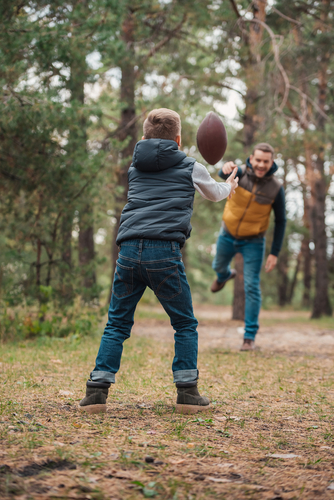
One of my fondest memories as a young boy was playing catch with a football with my dad. He could throw a football a mile. At least it seemed that far back then. Whenever I would go deep for one of his long passes, he would remind me that, “If you can touch it, you can catch it.” To do so, I learned to concentrate and look the ball into my hands and to catch with soft hands. All very valuable skills to have in just about every sport. His words of encouragement also taught me not to settle for mediocrity, but to strive to be as good as I could be. What else could I accomplish if I expected even more from myself?
When I was about nine years old, my Dad took me on a trip to see a Notre Dame home football game. It was a bitter cold November day, but I loved every minute of that unforgettable trip. Toward the end of the game, a Notre Dame player made a sharp cut near his team’s bench, forcing a chunk of sod to come loose and flip up in the air. The Notre Dame coach, Ara Parseghian, waited until the play was over, then he walked over and replaced the chunk of sod, tamping it down with his feet. My dad watched him the entire time. After the game ended, we walked out onto the field. My dad walked over to that very spot where Coach Parseghian had replaced the sod. He stood on that spot and said, “This is hallowed ground.” It was my Dad’s way of showing respect and to honor one of Notre Dame’s best coaches. Where great men have walked, on the gridiron or field of battle, in schools, churches, laboratories or factories, we should remember them and honor what they have accomplished.
From 7th grade through my senior year in high school, my dad came to everyone one of my basketball games. He was also there for every one of my Pop Warner football and Little League baseball games, as well. He never coached me, rarely said much before, during, or after my games, but knowing he was there was important to me. In my last year of high school basketball, as I struggled to remain a starter as a 5’3” point guard, I would search for my dad just before the tip-off. From the stands, he would always smile and wink at me. It was all the encouragement that I needed. Isn’t there a saying that showing up is 90% of life? It sure was true for me about my dad.
These lessons might seem trivial or even silly. But for some reason they have stayed with me for nearly half a century. I’m not exactly sure why, but maybe the reason why really doesn’t matter.
Please help me grow my readership by forwarding this to a friend(s). In the meantime, stay tuned for my next newsletter. Thanks!
Michael Kayes
*These views are my personal opinions and are not the viewpoints of any company or organization.