162nd Edition
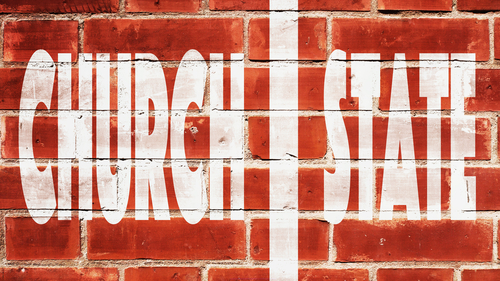
The Separation of Church and State
The First Amendment states that Congress shall make no law respecting an establishment of religion, or prohibiting the free exercise thereof; The point here is for the government to be completely unbiased and uninvolved regarding religion. Essentially, we are free to exercise our religious beliefs in any manner we choose. From a religious perspective we can be anything we want to be without interference, input, or guidance from the federal government. Known as the Establishment Clause, the separation of church and state is one of the foundation posts of our republic.
When thinking about this issue, it seems appropriate to remember what John Adams famously wrote – “Our Constitution was made only for a moral and religious people. It is wholly inadequate to the government of any other.” Representative government will operate best when everyone involved utilizes a moral compass in every aspect of life. Personally, professionally, in communities and in leadership roles at the local or national level. What makes the concept espoused by Adams complicated is that people can be moral without religion but can also be religious without being moral.
Given this reality, several questions come to mind. First, who is responsible for encouraging and modeling the use of a moral compass? Second, who holds us accountable when we fall short? Third, who defines what constitutes a true moral compass? Let me try to answer each of those questions.
The answer to the first question is simple. We all are. Dedicated parents and grandparents do this every day as they pass along wisdom and truth to the next generations. Teachers, coaches, pastors, and civic leaders do the same. Moral compasses for the latest generation are based on traditions, timeless truths, experience, and wisdom, as well as the creative energy and innovation that every new generation provides. While morality is constantly being molded, tested, challenged, and revised, certain common threads have endured over time. Honesty, loyalty, bravery, and honor have been foundation posts of a moral compass through the ages. I’m not sure a moral compass could even exist without those four key elements.
Throughout history, there have been periods influenced and even led by destructive fringe elements. Today, social media has made the voice of the fringe element omnipresent, putting significant pressure on our moral compass. One unfortunate reaction to this is to decide that truth is subjective and based more on feelings than traditions and empirical evidence. Bombarded with misinformation, our moral compass is being challenged at its core. Princeton Professor Robert George offers wise advice by encouraging us all to be relentless seekers of truth and courageous speakers of truth.
On to the second question – Who holds us accountable? The answer is no one. The elites and powerful seem to evade accountability. Worse over, in today’s climate of hypersensitivity, people intent on destroying traditional values and even western civilization don’t seem accountable either.
It is the third question that is the most difficult to answer. Who defines what constitutes a true moral compass? Our country has always struggled with this question. Perhaps we always will. What seems completely idiotic or even evil to one side, might seem entirely acceptable and appropriate to the other side. That has been the continual state of the great American Experiment. Somehow, we find a way to adapt, reach compromise, and move forward. There has been no nation quite like the United States of America in the history of the world. Why have we been so successful and what will we accomplish in the future? In the meantime, are we in a state of moral decline? If so, what is the role of the church in establishing and nurturing moral behavior? Do we expect too much, or too little, from our spiritual leaders when it comes to setting moral guidelines and serving as a mechanism for accountability? (Great questions for future blogs…)
At this point in today’s ramblings, I feel compelled to turn to C.S. Lewis. He identifies what I think is the defining element of our republic. Collectively, we have this internal sense that we ought to do the right thing even when circumstances make it challenging to do so. This eternal sense, what Lewis calls “The Law of Human Nature” has always existed. It never leaves us.
Individually and collectively, we can and have done horrible things, but over time, we tend to find the right path. How do we find the light after wandering into darkness? It is simply because God never leaves us. He never leaves us even when we reject Him, nor when we place false gods before Him. He is our savior and redeemer. He is here for us all. The religious and irreligious, those we love and those we despise. No amendment, no fringe-minded absurdity, and no mistaken belief, sincere or insincere, can separate us from God’s love and grace.
No matter how controversial or unpopular it may make us, we should never shy away from sharing this good news through our thoughts, deeds, and especially in our interactions with our fellow brothers and sisters.
Please help me grow my readership by forwarding this to a friend(s). In the meantime, stay tuned for my next newsletter. Thanks!
Michael Kayes
*These views are my personal opinions and are not the viewpoints of any company or organization.