182nd Edition
Allegiance
I recently finished an amazing and thought-provoking book by the late Charlie Kirk, “Stop in the Name of God.” It talks about honoring the Sabbath. In his book, Kirk raises an interesting question – To whom do we pledge our allegiance? This question got me thinking about the Pledge of Allegiance, among other things…
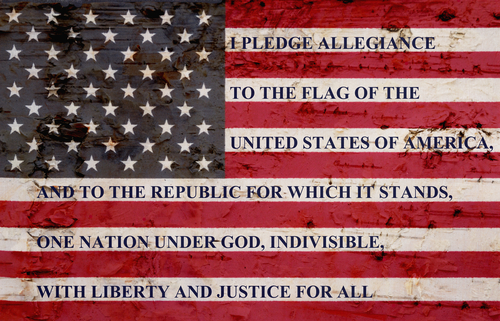
The Pledge of Allegiance, first introduced in 1892, reads as follows – I pledge allegiance to the Flag of the United States of America, and to the Republic for which it stands, one Nation under God, indivisible, with liberty and justice for all. Today, most states continue this tradition in schools although individual students can opt-out, and in essence cannot be forced to recite it. I suspect, in these opt-out cases, it is the parents who object, not the students. Sort of begs the question – Just why would a parent object?
Allegiance requires a commitment or a promise of loyalty, devotion, or duty to something. Some people struggle making commitments, keeping promises, or remaining loyal, especially when it requires personal sacrifice. These character traits, not uncommon, are certainly not man’s most honorable ones.
Does a country need its citizens’ allegiance? Perhaps a better question is this – Does the absence of loyalty or devotion to duty and self-sacrifice, make a country stronger or weaker? Rather a silly question, isn’t it?
Throughout a person’s life, there are different causes or opportunities requiring a pledge of allegiance. Family, church, community, and country, to name a few. When there isn’t a sense of allegiance to something important, there is a lack of connection, maybe even an isolating sense of self-absorption. Is that common or uncommon today?
How many people in your life can you really count on? How many people in your life can really count on you?
No one should take the decision of a pledge of allegiance lightly. It is a serious commitment. In the first thirty days after the attack on Pearl Harbor, approximately 134,000 men enlisted in the Armed Services. Prior to December 7, 1941, there were less than two million men in active duty, representing the 17th largest force in the world. By the end of the war there were over twelve million men and women serving our country in the armed forces. If our country were attacked today, how many young people would enlist? Has allegiance to our country waned? If so, why?
Today, there is an ongoing debate about the pros and cons of nationalism. Arguably, there is a good side and a bad side to it. Being proud to be a citizen, accepting your civic duty, looking for ways to help the less fortunate are positive ways to express a sense of national pride. Conversely, becoming xenophobic or discriminating against ethnic minorities or refusing to help those in need are not appropriate ways to express nationalist sentiments. Both exist today and when we debate nationalism, we should be careful to distinguish between positive and negative means of expression.
In this book, his last before he was assassinated, Kirk challenges us to keep the Sabbath. Reserving one day of rest and quiet communion with God, away from the many distractions that dominate our lives during the other six days of the week. As Kirk explains, the day of the week isn’t as important as the allegiance to God’s commandment to rest on the seventh day. Rest, not because we need it, but because God rested, and because our allegiance to the Sabbath demonstrates and strengthens our allegiance to God.
Allegiances give our life meaning. They serve as our foundation, impacting everything else we do. Are we loyal and trustworthy? Reliable and dependable? Willing to sacrifice for a worthy cause? Do we put God before self? What kind of world would we live in if the answer to these questions were no?
I’m wondering if each of us should start the day with a personal pledge of allegiance. What would yours include? I’m reminded of these words from Abraham Lincoln – “I like to see a man proud of the place in which he lives. I like to see a man live so that his place will be proud of him.”
You can’t do either without allegiance, can you?
Please help me grow my readership by forwarding this to a friend(s). In the meantime, stay tuned for my next newsletter. Thanks
Michael Kayes
*These views are my personal opinions and are not the viewpoints of any company or organization.