156th Edition
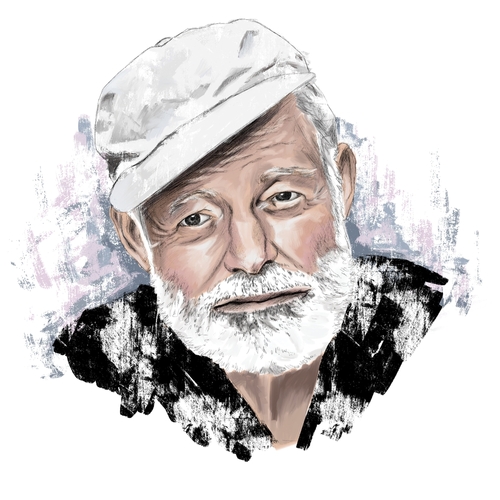
WWHD – What Would Hemingway Do?
It seems that every time some celebrity or politician talks about their childhood, they credit the extraordinary work ethic of a parent or grandparent that helped them climb the ladder of success. It appears they all like to claim some sort of a rags to riches story, all due to the hard work of someone else. On the surface, it makes perfect sense to do this. As Barton Swaim points out in a recent article in the Wall Street Journal – “Vance, Newsom and Tales of Want,” both sides of the political aisle are guilty of what he calls, “the commonest trope in politics.” Swaim makes an interesting statement in his article – “A ferocious work ethic was a virtue among our elders; today it’s evidence of systematic injustice.”
I thought I’d dig into that a little bit in today’s blog. From the Founding Fathers to the Greatest Generation, Americans have long been a nation of hard-working people. Just this past week I had a conversation with a retired police officer, who worked thirty-one years and never took a single day off… in thirty-one years! Stories like this about the Baby Boom generation, of which I am one, are common. It was just a way of life. We lived that way because we wanted to provide a better life for our families.
Finding ways to do more with less, to build things faster and to make mundane tasks easier to do, so we would have more time for more enjoyable activities, have all been part of the technological revolution. Today, in many ways, status is measured by how many gadgets one has and how little time one spends doing any task manually. Personal robots can clean, vacuum, mow the lawn, clean the pool, wash the windows, while smart phone apps turn lights on and off, control the HAVC system, monitor the alarm system and so much more. Beyond all this we have a plethora of virtual reality applications and experiences. In essence, the more technology can do, the less we have to do.
And then there is AI. It can think for us. Perhaps better than we can, certainly much quicker. In the technological age, we seem obsessed with finding ways to do, well, everything that needs to be done, with the least amount of human effort.
Last week, I flew to Boston. I was the only person on the plane who did not have a roller bag. I had a green REI duffle bag and a North Face backpack. I felt so out of place hiking through the airports with my duffle bag on one shoulder and my backpack on the other. Still, it served as my workout for the day. Perhaps there is some value in doing things the hard way.
AI can write a report or essay, or even a book in seconds. I wonder if Earnest Hemingway would have used AI if it were available when he wrote To Whom the Bell Tolls or The Old Man and The Sea?
Today you can take a pill to lose weight. Will that make exercise and self-control less important? I imagine someday soon, there will be a pill I can take to run faster and maybe even jump higher. Will I take them and stop training as hard?
How exactly did a strong work ethic become a sign of injustice? I guess it makes sense to assert that claim if your goal is to have the government redistribute wealth and eliminate income inequality. But as Swaim rightly points out, if the government does this then a strong work ethic isn’t necessary. What will America become without a strong work ethic? Has technology already made one obsolete? Swaim’s concluding point is this: Politicians credit a previous generation’s work ethic, but are bent on making it unnecessary in the current generation. But he doesn’t ask why. I suspect the reason why politicians do this has something to do with their insatiable thirst for power and control.
In my mind, it comes down to this – Can government provide an effective safety net, help provide opportunities for all, while encouraging a strong work ethic, and preventing destructive cycles of poverty and dependency? Its track record, since the New Deal, is a mixed bag. As government continues to expand, it is unlikely to become less intrusive in our lives. As future versions of AI become more powerful, what will there be left for us to do? If everything we have to do becomes too easy, how will character be forged, how will muscles be developed, and how will perseverance and determination be learned?
Perhaps someday I’ll use a roller bag. But not just yet.
Please help me grow my readership by forwarding this to a friend(s). In the meantime, stay tuned for my next newsletter. Thanks!
Michael Kayes
*These views are my personal opinions and are not the viewpoints of any company or organization.